Recommended camera settings#
Focal length needed to frame it#
For a subject about 42 cm long filling a third or half of the frame width horizontally.
| Distance | ⅓ of frame (FF) | ½ of frame (FF) | ⅓ of frame (APS-C) | ⅓ of frame (MFT) |
|---|---|---|---|---|
| 5 m (16 ft) | 136 mm | 203 mm | 91 mm | 68 mm |
| 10 m (33 ft) | 272 mm | 406 mm | 181 mm | 136 mm |
| 15 m (49 ft) | 408 mm | 609 mm | 272 mm | 204 mm |
| 20 m (66 ft) | 544 mm | 813 mm | 363 mm | 272 mm |
| 30 m (98 ft) | 816 mm | 1,219 mm | 544 mm | 408 mm |
| 50 m (164 ft) | 1,360 mm | 2,032 mm | 906 mm | 680 mm |
About the Black-necked Stilt#
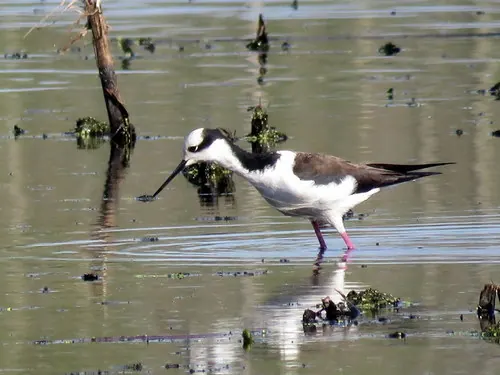
The black-necked stilt (Himantopus mexicanus) is a locally abundant shorebird of American wetlands and coastlines. It is found from the coastal areas of California through much of the interior western United States and along the Gulf of Mexico as far east as Florida, then south through Central America and the Caribbean to Ecuador and the Galápagos Islands. The northernmost populations, particularly those from inland, are migratory, wintering from the extreme south of the United States to...
Summary adapted from Wikipedia via iNaturalist (CC BY-SA 4.0).
Field-craft tips#
- Reflections in calm shallow water make elegant frames.
- Herons and egrets stand still for long periods — wait for the strike or take-off and use continuous AF.
- Sightings peak in April and May, which is when you'll have the most chances.
Ethics#
- The welfare of the animal comes first: if it changes its behaviour because of you, you are too close.
- Stay on trails, respect closures around nests, leks, dens and haul-outs.
- Avoid playback and baiting in sensitive seasons; never bait predators.
- Don't share precise locations of rare, nesting or roosting animals publicly.
More Stilts and Avocets#
Frequently asked questions#
What lens do I need to photograph a Black-necked Stilt?
At about 42 cm long, a black-necked stilt fills a third of a full-frame image at 10 m with roughly 272 mm, or at 20 m with 544 mm.
What shutter speed should I use for a Black-necked Stilt?
1/500 s when it's still; 1/2000 s for action.
When is the best time to photograph a Black-necked Stilt?
Observations in North America peak in April and May. Early morning and late afternoon give the best light and activity.
Sources & licences#
- iNaturalist — Observation data CC BY-NC; photo licence as credited
- Wikipedia — CC BY-SA 4.0
Last updated October 03, 2026 · How we calculate · Sources