Recommended camera settings#
Focal length needed to frame it#
For a subject about 12 cm long filling a third or half of the frame width horizontally. Small birds demand long lenses and a close approach — a blind or feeder setup helps.
| Distance | ⅓ of frame (FF) | ½ of frame (FF) | ⅓ of frame (APS-C) | ⅓ of frame (MFT) |
|---|---|---|---|---|
| 5 m (16 ft) | 434 mm | 629 mm | 289 mm | 217 mm |
| 10 m (33 ft) | 868 mm | 1,259 mm | 579 mm | 434 mm |
| 15 m (49 ft) | 1,302 mm | 1,888 mm | 868 mm | 651 mm |
| 20 m (66 ft) | 1,736 mm | 2,517 mm | 1,157 mm | 868 mm |
| 30 m (98 ft) | 2,604 mm | 3,776 mm | 1,736 mm | 1,302 mm |
| 50 m (164 ft) | 4,340 mm | 6,294 mm | 2,893 mm | 2,170 mm |
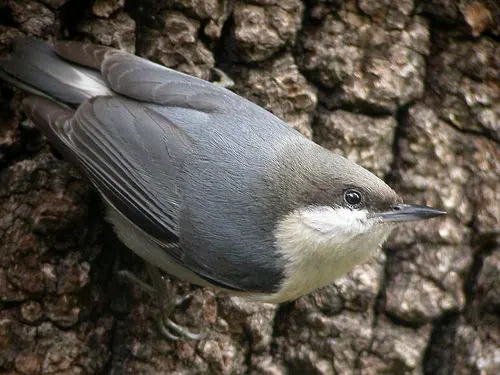
About the Pygmy Nuthatch#
The pygmy nuthatch (Sitta pygmaea) is a tiny songbird, about 10 cm (4 inches) long and about 10 grams in weight. It ranges from southern British Columbia south through various discontinuous parts of the western U.S. (northwest U.S., Sierra Nevada range, southern Rockies, etc.), to central Mexico. It is usually found in pines (especially ponderosa pines), Douglas-firs, and other conifers.
Summary adapted from Wikipedia via iNaturalist (CC BY-SA 4.0).
Field-craft tips#
- They work down trunks head-first — try a low angle looking up.
- Trunk-clinging birds sit in shade: watch your shutter speed and use zone AF to avoid focusing on bark.
- Sightings peak in May, June, July, August and September, which is when you'll have the most chances.
- Tiny subjects: get close with a hide or feeder perch rather than cropping heavily.
Ethics#
- The welfare of the animal comes first: if it changes its behaviour because of you, you are too close.
- Stay on trails, respect closures around nests, leks, dens and haul-outs.
- Avoid playback and baiting in sensitive seasons; never bait predators.
- Don't share precise locations of rare, nesting or roosting animals publicly.
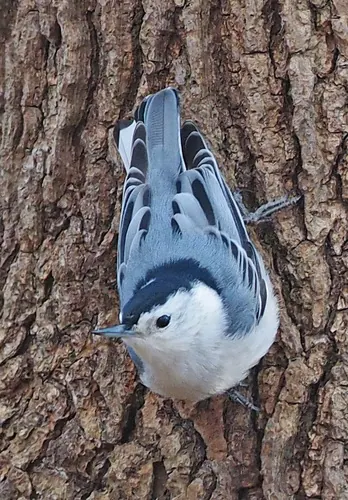
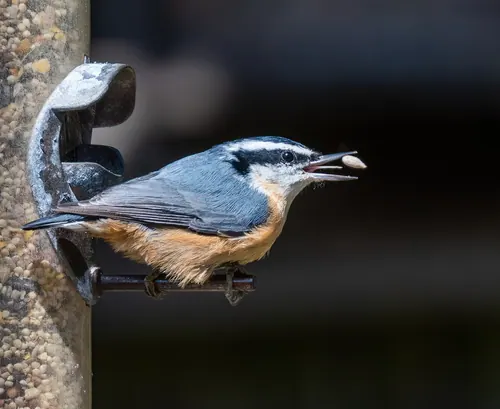
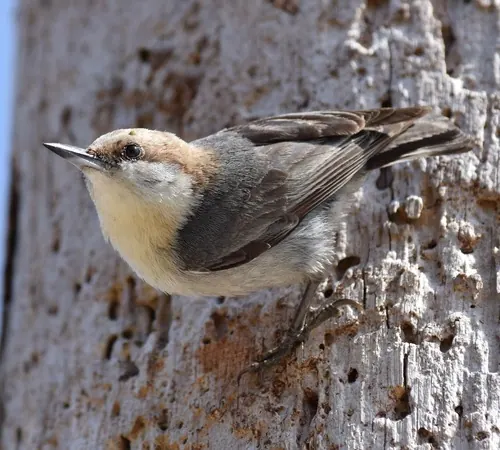
More Nuthatches#
Frequently asked questions#
What lens do I need to photograph a Pygmy Nuthatch?
At about 12 cm long, a pygmy nuthatch fills a third of a full-frame image at 10 m with roughly 868 mm, or at 20 m with 1,736 mm.
What shutter speed should I use for a Pygmy Nuthatch?
1/800 s when it's still; 1/2500 s for action.
When is the best time to photograph a Pygmy Nuthatch?
Observations in North America peak in May, June, July, August and September. Early morning and late afternoon give the best light and activity.
Sources & licences#
- iNaturalist — Observation data CC BY-NC; photo licence as credited
- Wikipedia — CC BY-SA 4.0
Last updated October 03, 2026 · How we calculate · Sources