Recommended camera settings#
Focal length needed to frame it#
For a subject about 14 cm long filling a third or half of the frame width horizontally. Small birds demand long lenses and a close approach — a blind or feeder setup helps.
| Distance | ⅓ of frame (FF) | ½ of frame (FF) | ⅓ of frame (APS-C) | ⅓ of frame (MFT) |
|---|---|---|---|---|
| 5 m (16 ft) | 404 mm | 588 mm | 270 mm | 202 mm |
| 10 m (33 ft) | 809 mm | 1,176 mm | 539 mm | 404 mm |
| 15 m (49 ft) | 1,213 mm | 1,765 mm | 809 mm | 607 mm |
| 20 m (66 ft) | 1,618 mm | 2,353 mm | 1,078 mm | 809 mm |
| 30 m (98 ft) | 2,426 mm | 3,529 mm | 1,618 mm | 1,213 mm |
| 50 m (164 ft) | 4,044 mm | 5,882 mm | 2,696 mm | 2,022 mm |
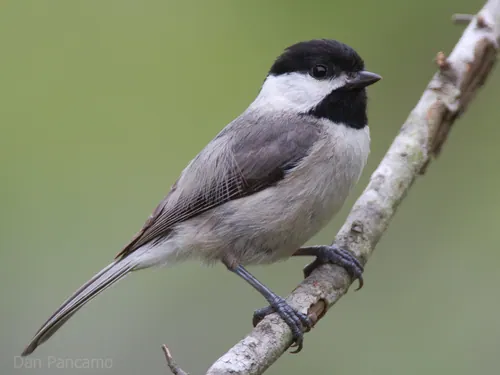
About the Carolina Chickadee#
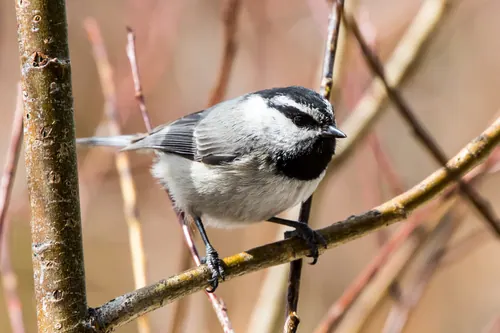
The Carolina chickadee (Poecile carolinensis) is a small passerine bird in the tit family Paridae. It is often placed in the genus Parus with most other tits, but mtDNA cytochrome b sequence data and morphology suggest that separating Poecile more adequately expresses these birds' relationships (Gill et al., 2005). The American Ornithologists' Union has been treating Poecile as distinct genus for some time already.
Summary adapted from Wikipedia via iNaturalist (CC BY-SA 4.0).
Field-craft tips#
- Very approachable at feeders — set up a natural perch near the feeder.
- Winter flocks make them easy to find.
- Bird-eye AF with continuous focus (AF-C/AI Servo); fill at least a third of the frame.
- Sightings peak in January, February, March and April, which is when you'll have the most chances.
Ethics#
- The welfare of the animal comes first: if it changes its behaviour because of you, you are too close.
- Stay on trails, respect closures around nests, leks, dens and haul-outs.
- Avoid playback and baiting in sensitive seasons; never bait predators.
- Don't share precise locations of rare, nesting or roosting animals publicly.
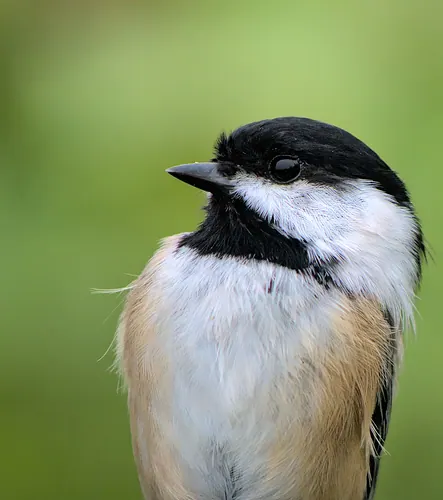
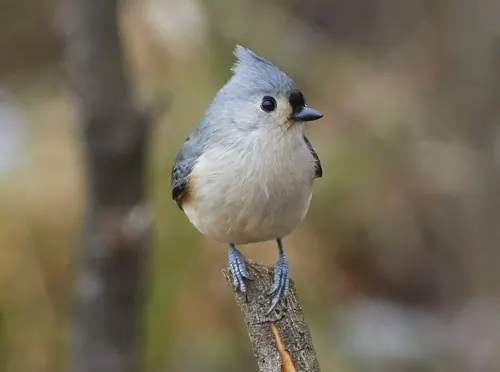
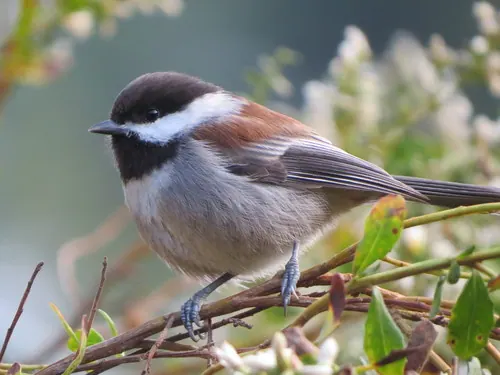
More Tits, Chickadees, and Titmice#
Frequently asked questions#
What lens do I need to photograph a Carolina Chickadee?
At about 14 cm long, a carolina chickadee fills a third of a full-frame image at 10 m with roughly 809 mm, or at 20 m with 1,618 mm.
What shutter speed should I use for a Carolina Chickadee?
1/800 s when it's still; 1/2500–1/3200 s for action.
When is the best time to photograph a Carolina Chickadee?
Observations in North America peak in January, February, March and April. Early morning and late afternoon give the best light and activity.
Sources & licences#
- iNaturalist — Observation data CC BY-NC; photo licence as credited
- Wikipedia — CC BY-SA 4.0
Last updated October 03, 2026 · How we calculate · Sources