Recommended camera settings#
Focal length needed to frame it#
For a subject about 41 cm long filling a third or half of the frame width horizontally.
| Distance | ⅓ of frame (FF) | ½ of frame (FF) | ⅓ of frame (APS-C) | ⅓ of frame (MFT) |
|---|---|---|---|---|
| 5 m (16 ft) | 141 mm | 210 mm | 94 mm | 70 mm |
| 10 m (33 ft) | 282 mm | 421 mm | 188 mm | 141 mm |
| 15 m (49 ft) | 422 mm | 631 mm | 282 mm | 211 mm |
| 20 m (66 ft) | 563 mm | 841 mm | 375 mm | 282 mm |
| 30 m (98 ft) | 845 mm | 1,262 mm | 563 mm | 422 mm |
| 50 m (164 ft) | 1,408 mm | 2,103 mm | 939 mm | 704 mm |
About the Cliff Chipmunk#
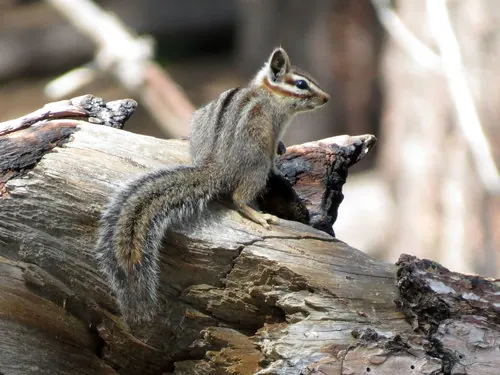
The cliff chipmunk (Tamias dorsalis) is a small, bushy-tailed squirrel that typically lives along cliff walls or boulder fields bordering Pinyon-juniper woodlands in the Western United States and Mexico (commonly spotted in northern Arizona to Colorado). Cliff chipmunks are very agile, and can often be seen scaling steep cliff walls. Cliff chipmunks do not amass body fat as the more common ground squirrel does.
Summary adapted from Wikipedia via iNaturalist (CC BY-SA 4.0).
Field-craft tips#
- Great subjects for learning — confiding in parks.
- Get your lens at the animal's eye level.
- Get down to eye level; a long lens with close focus (or an extension tube) helps with small subjects.
- Sightings peak in May, June, July and August, which is when you'll have the most chances.
Ethics#
- The welfare of the animal comes first: if it changes its behaviour because of you, you are too close.
- Stay on trails, respect closures around nests, leks, dens and haul-outs.
- Avoid playback and baiting in sensitive seasons; never bait predators.
- Don't share precise locations of rare, nesting or roosting animals publicly.
More Squirrels#
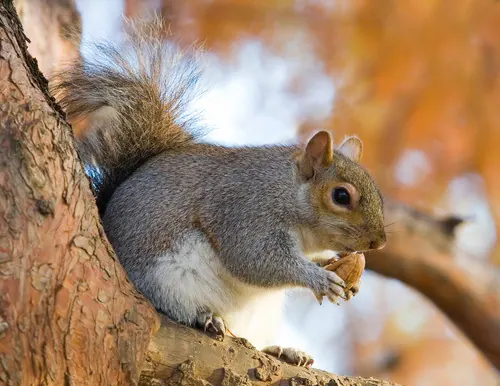 Eastern Gray SquirrelSciurus carolinensis
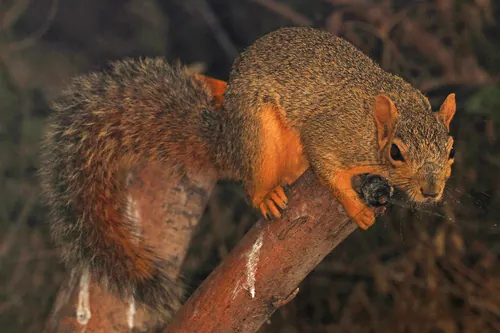 Eastern Fox SquirrelSciurus niger
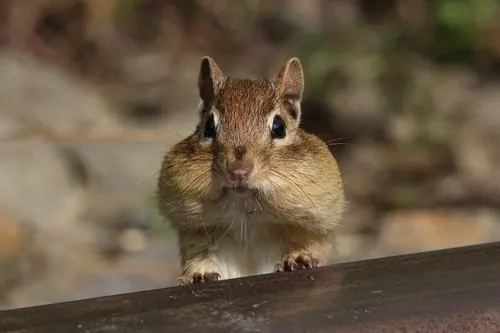 Eastern ChipmunkTamias striatus
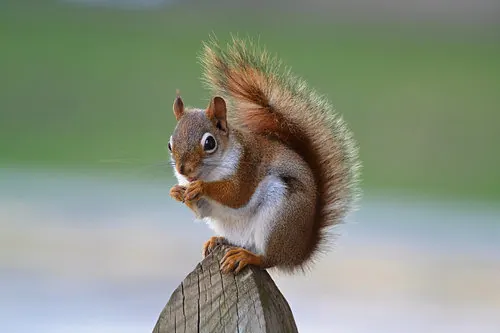 American Red SquirrelTamiasciurus hudsonicus
California Ground SquirrelOtospermophilus beecheyi
American Red SquirrelTamiasciurus hudsonicus
California Ground SquirrelOtospermophilus beecheyi
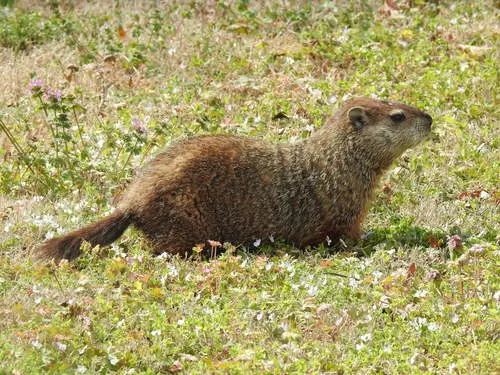 GroundhogMarmota monax
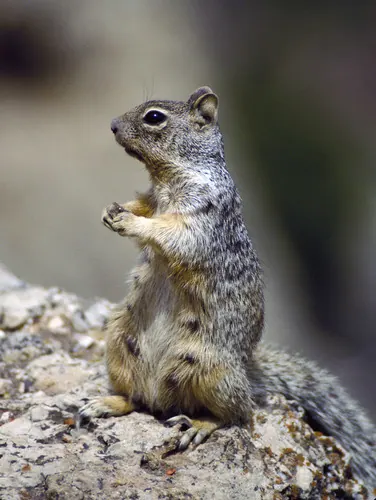 Rock SquirrelOtospermophilus variegatus
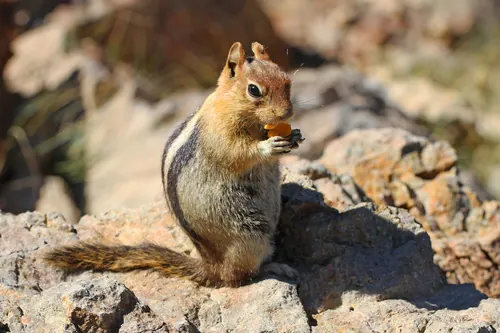 Common Golden-mantled Ground SquirrelCallospermophilus lateralis
Frequently asked questions#
What lens do I need to photograph a Cliff Chipmunk?
At about 41 cm long, a cliff chipmunk fills a third of a full-frame image at 10 m with roughly 282 mm, or at 20 m with 563 mm.
What shutter speed should I use for a Cliff Chipmunk?
1/800 s when it's still; 1/2000 s for action.
When is the best time to photograph a Cliff Chipmunk?
Observations in North America peak in May, June, July and August. Early morning and late afternoon give the best light and activity.
Sources & licences#
- iNaturalist — Observation data CC BY-NC; photo licence as credited
- Wikipedia — CC BY-SA 4.0
Last updated October 03, 2026 · How we calculate · Sources