Recommended camera settings#
Focal length needed to frame it#
For a subject about 9 cm long filling a third or half of the frame width horizontally. Small birds demand long lenses and a close approach — a blind or feeder setup helps.
| Distance | ⅓ of frame (FF) | ½ of frame (FF) | ⅓ of frame (APS-C) | ⅓ of frame (MFT) |
|---|---|---|---|---|
| 5 m (16 ft) | 583 mm | 833 mm | 389 mm | 292 mm |
| 10 m (33 ft) | 1,166 mm | 1,667 mm | 777 mm | 583 mm |
| 15 m (49 ft) | 1,749 mm | 2,500 mm | 1,166 mm | 875 mm |
| 20 m (66 ft) | 2,332 mm | 3,333 mm | 1,555 mm | 1,166 mm |
| 30 m (98 ft) | 3,498 mm | 5,000 mm | 2,332 mm | 1,749 mm |
| 50 m (164 ft) | 5,830 mm | 8,333 mm | 3,887 mm | 2,915 mm |
About the Big Brown Bat#
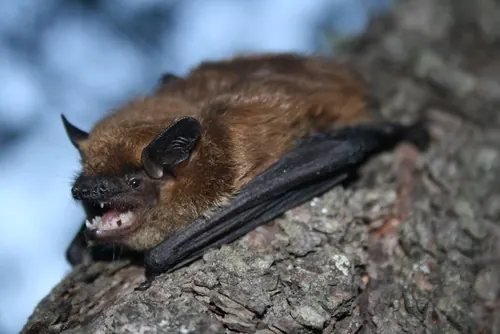
The big brown bat (Eptesicus fuscus) is a widespread species of bat found throughout North America, Central America, the Caribbean, and extreme northern South America.
Summary adapted from Wikipedia via iNaturalist (CC BY-SA 4.0).
Field-craft tips#
- Photograph emerging bats at dusk with high-speed flash — never at roosts in winter.
- Bats need high-speed flash with an IR beam trigger; never photograph roosting bats in winter hibernation.
- Sightings peak in July and August, which is when you'll have the most chances.
- Tiny subjects: get close with a hide or feeder perch rather than cropping heavily.
Ethics#
- The welfare of the animal comes first: if it changes its behaviour because of you, you are too close.
- Stay on trails, respect closures around nests, leks, dens and haul-outs.
- Avoid playback and baiting in sensitive seasons; never bait predators.
- Don't share precise locations of rare, nesting or roosting animals publicly.
More Evening Bats#
Frequently asked questions#
What lens do I need to photograph a Big Brown Bat?
At about 9 cm long, a big brown bat fills a third of a full-frame image at 10 m with roughly 1,166 mm, or at 20 m with 2,332 mm.
What shutter speed should I use for a Big Brown Bat?
1/250 s when it's still; 1/20,000 s flash duration for action.
When is the best time to photograph a Big Brown Bat?
Observations in North America peak in July and August. Early morning and late afternoon give the best light and activity.
Sources & licences#
- iNaturalist — Observation data CC BY-NC; photo licence as credited
- Wikipedia — CC BY-SA 4.0
Last updated October 03, 2026 · How we calculate · Sources